Services
Symbiotic Dynamics brings futuristic technological ideas to life. We provide research-grade AI, machine learning and robotics services, spanning independent capability prototyping, technical direction setting, and preparation of high-stakes technology demonstrations.
Our work focuses on intelligent systems in interaction with the human: large-scale language models, robotics, multi-agent and embodied AI, as well as graph-based systems and innovative, AI-first governance.
Explore & Build
Engineering of new capabilities, research, experimentation, and early-stage prototyping.
Lead
Establishment of tailored technical direction and setting up effective innovation teams.
Demonstrate
Preparation of convincing demonstrations of innovative capabilities for internal and external audiences.
Govern
Governance and assurance layers for autonomous and agentic systems, anchored in Policy Cards.
Service areas
We push innovation up the TRL-scale, from early idea to effective demonstration and compliant capability in production.
Independent AI Research & Prototyping
Independent exploration and prototyping of advanced AI, ML, language, graph and embodied systems.
- Research sprints
- Concept prototypes
- Innovating upon existing capability
Technical Direction & CTO Support
Setting of technical direction for innovation, architecture and team structures for AI-intensive initiatives.
- Technology and architecture assessment
- Team alignment & role structure
- Roadmaps
Demo Excellence & High-Stakes Readiness
Stabilisation and refinement of critical technology demonstrations for high-stakes presentations.
- Demo audit & refactoring
- Runbooks, fallbacks & narrative preparation
- Team roles & responsibilities
Policy Cards & AI Governance
Governance, control and audit layers for autonomous and agentic systems using Policy Cards.
- AI-first Runtime governance
- Machine-readable controls
- Pilot programmes
Independent AI Research & Prototyping
Symbiotic Dynamics conducts research and prototyping for intelligent systems. Work spans from traditional ML, language models, knowledge graphs, to embodied systems, robotics, autonomous systems, and related technologies.
Our emphasis is on future capability development and not only the development of individual models in isolation. We harness latest technological developments to create new value adding capabilities in relevant domains. This includes identifying feasibility, architectural possibilities, testing assumptions and building prototypes. The aim is to establish what is technically feasible and beneficial before larger commitments are made. How can we achieve new useful capability in the simplest way possible?
Scope of work
- Formation of new capability through focused technical exploration
- Early-stage research
- Prototyping and experimental evaluation
- Architecture exploration and capability mapping
- Assessment of integration requirements
- Validation of technical feasibility
Domains
- Data extraction and natural language processing
- Large language models, retrieval-augmented systems
- Knowledge graphs, ontologies, relationship extraction
- Graph machine learning and relational reasoning
- Agentic AI, multi-agent systems and orchestration
- Embodied AI, robotics and simulation environments
- AI Governance at runtime
Engagement patterns
- Research sprints with defined questions and technical options
- Prototype development to test feasibility of a new idea
- Experimental workflows, e.g., experimental environments for embodied or digital agents
- Technical input and prototypes supporting funding or innovation bids
Knowledge-graph based systems
The application of knowledge graphs as the primary data and memory layer for intelligent systems such as AI agents. KGs preserve detailed semantic information, i.e., the nature of relationships between entities.
- Ontology and schema design aligned to domain requirements
- Entity and relation extraction from text and semi-structured sources
- Graph construction and consolidation
- Integration with LLMs for semantic retrieval
- KGs as foundation for memory for agentic-AI systems
Example applications include multimodal data fusion, data retrieval with reduced hallucinations, recommendation systems, cross-system relationship discovery, domain-independent data workflows.
LLM workflows and agents
The design and implementation of language model systems and autonomous agentic systems that combine tool use, retrieval from knowledge bases, task-planning, and integration with external APIs and data sources.
- Chain-of-thought reasoning patterns for explainability
- Tool-calling architectures and function integration
- Retrieval-augmented generation from vector and graph stores
- Multi-step reasoning workflows and autonomous agent orchestration
- Privacy preserving architectures
Example applications include multilingual retrieval systems with reduced hallucinations and autonomous LLM-based agentic systems.
Graph machine learning
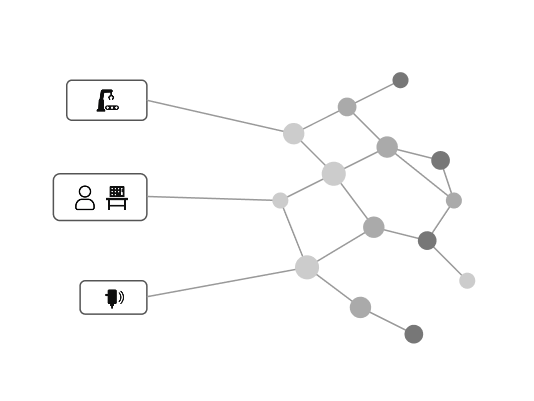
The application of graph neural networks and relational learning methods to enable predictions, anomaly detection and relationship analysis across connected entities.
- Link prediction, temporal link prediction, node and edge classification
- Explainability methods
- Geometric graph representation learning for massive datasets
- Hybrid knowledge graph + graph ML methods
- Graph representation of physical and digital system topologies
Example applications include predictive maintenance systems for physical assets and manufacturing, and supply chain risk analysis.
Embodied and agentic systems
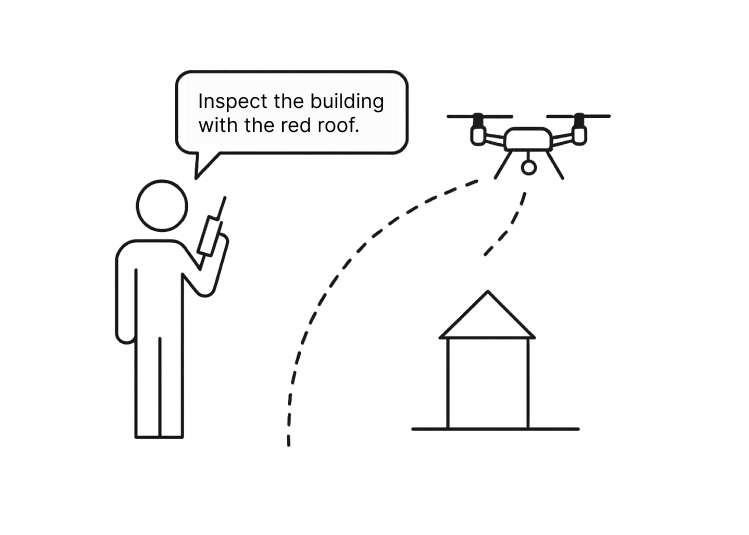
Development of autonomous agents operating in physical or simulated environments, combining perception and execution for tasks requiring spatial reasoning and physical interaction. From LLMs to vision-language-action models (VLAs).
- Perception pipelines for sensor fusion (vision, lidar, audio)
- Deployment of physical platforms and real-world testing
- Integration with platform specific low-level autonomous capabilities
- Human-machine teaming: Human-in-the-loop and human-on-the-loop systems
- Seamless human interaction with complex engineered systems
Example applications include inspection robotics and search-and-rescue systems.
Technical Direction & CTO Support
Work in this area focuses on creating and instantiating an effective technology development & innovation strategy for a specific goal. We provide structured technical direction for innovation, which enables to move initial ideas into demonstratable products or create new hands-on capability. This operates alongside existing leadership structures including CEOs, CTOs and R&D heads.
The scope includes evaluation of current technical capabilities, identification of feasible pathways, opportunities and risks, aligning teams and methods, and support for architectural and organisational decisions.
Focus areas
- Assessment of current technical and organizational capability
- Identification of capability gaps, constraints and development pathways
- Team structure & roles assessment and alignment
- Integration of new capability into existing systems
- Guidance on technical hiring priorities
- Enhancement of technical credibility
T0 Capability Assessment
Evaluation of current system state, identification of strengths, weaknesses and constraints, and recommendations for technical direction, depending on goals.
- Architecture review & components assessment
- Workflow & team review
- Technology vs. business needs assessment
- Technical deep dive
- Innovation proposal for new technical capability
Alignment of Team & Technology
Setting the foundations for growth for the technical team and product.
- Hands-on embedding in the technical team
- Goal alignment across the team
- Establishing an agile sprint rhythm with clear responsibilities and best practice day-to-day workflows
- Defining immediate and future priorities
- Restructuring the technical product architecture to align with team and goals
- Preparation for specific external-facing opportunities
Ongoing Strategic Leadership
Periodic involvement at leadership level to provide input on technical direction and major technical decisions.
- Supporting critical technical decisions
- Review of risks, challenges and opportunities
- Support during hiring and programme shaping
Demo Excellence & High-Stakes Readiness
Demonstrations often form the basis for internal decisions, external communication, or funding discussions. We focus on preparing clear, coherent demonstrations from existing prototypes, to deliver credibility when it counts.
Work includes auditing the current demo stack, stabilising dependencies, reducing unnecessary complexity, clarifying the core storyline, preparing runbooks and fallback procedures. Technical presentation and framing form part of the work where relevant.
From internal prototype to reusable asset
Current state
Fragile internal prototype or partial story, with dependencies on team members and manual interventions.
Prepared demo
Stable, coherent configuration ready for presentation with documented setup, clear narrative and fallback procedures.
Reusable asset
Maintained internal artefact that can be reliably deployed for multiple audiences rather than a single-use demonstration.
Typical scenarios
Time-constrained stabilisation
Rapid preparation of a demonstration under tight deadlines, focusing on core functionality, environment stability and narrative clarity.
Flagship demo design
Development of a signature demonstration for recurring use, including technical architecture, presentation materials and maintenance protocols.
Demo-as-a-product practice
Establishment of internal processes for treating demonstrations as maintained products, with version control, testing and documentation standards.
Technical presentation support
Direct presentation of technical systems to executive or external audiences and boosting technical credibility for the demo.
Policy Cards & AI Governance
We support organizations developing their AI governance systems. Policy Cards provide machine-readable control and governance for autonomous and intelligent agentic systems. They enable a clean separation between AI engineering and AI governance roles & responsibilities in organizations.
Application domains, pilot programmes and implementation support are detailed below.
Policy Cards form the pillar for AI Governance.
View Policy CardsHow engagements are structured
Engagements are scoped with defined objectives, and concrete outputs. Formats vary depending on whether the work involves research, prototyping, decision support, or demonstration preparation.
At the core of all engagements is our meticulous focus on understanding the goals and value adding opportunities. We emphasise compactness, precision of outputs, and a balance between formal goal-setting and direct, informal communication that keeps work aligned and hands-on throughout the engagement.
Engagement formats
Focused work packages
Scope: Technical assessments, prototype development, demonstration preparation.
Typical duration: 2–8 weeks depending on scope and complexity.
Outputs: Technical documentation, working artefacts, architectural recommendations.
Advisory and external CTO involvement
Scope: Long-term strategic technical input and direction.
Typical pattern: Periodic sessions, document review, decision support, team alignment & leadership.
Focus: Directional decisions, major architectural shifts, hiring and team structure.
Research and programme collaboration
Scope: Participation in funded R&D projects or research consortia.
Role: Subject-matter expertise, work package design, technical deliverables.
Outputs: Research publications, prototype systems, technical reports.
Selected projects may incorporate collaborators in machine learning, physics, robotics or domain-specific fields, depending on scope.
Initiate a conversation
We invite you to get in touch to discuss your goals and explore which technical directions may be appropriate to support them.